|
Measuring Your Prescription
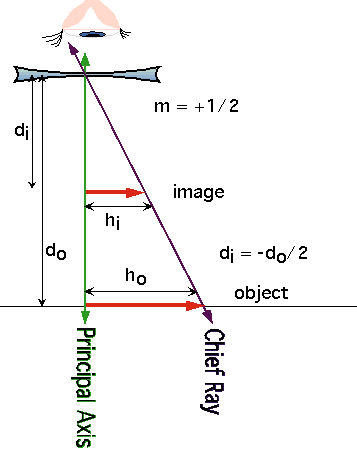
Most prescription eyeglasses use diverging lenses to correct for
myopia or nearsightedness. Such lenses create a virtual image nearer
to the viewer than the object at reduced magnification.
|
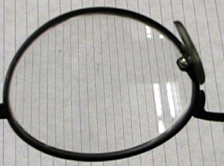 |
Hold a pair of glasses in your hand at
a FULL arm's length over evenly spaced long parallel lines (any ruled
paper).
By alternately look through one lens and then past it, raise and
lower the glasses until the magnified image of the lines is one-half
the
size of the object. At this point, the image through the lens will
show two lines apparently fitting into the space of one line viewed
past the lens. If they're your glasses, you WILL need someone else
to do the focusing on this looking over your shoulder. The more eye
relief (distance from lens to eye of viewer) used the more accurate
your measurements will be. |
| Measure the distance from the lined paper
to the center of the lens. This is do, and using this
measurement and the thin lens equations, you can determine the lens
power in diopters, also called the eyeglass
prescription.
|

|
Q1: Using
the thin lens formulas, show that when M = + 1 / 2 for a diverging
lens;
d i
= - d o
/ 2; and f = - d o
. Attach your proof to the sheet, together with a rough
ray sketch of this situation (show focal, parallel and chief
rays).
Q2: Determine
do for four separate eyeglass lenses. Use the relationship
Power (in diopters) = 1 / f (in meters) to determine the eyeglass
prescription in diopters.
As an example: if d o
= 33 cm; P = -3.3D. Write the focal length and diopter equivalence
for your four lenses on the sheet.
Q3:
What would be the focal length of a -1.75D and a -1.25D lens?
Q4: How
would a +1.75D lens differ from a -1.75D lens?
Q5: How
would an optometrist characterize the vision of a person with
these prescriptions?
|
| Dudley, Scott C. (1999). How to quickly estimate
the focal length of a diverging lens. The Physics Teacher 37(2),
p94. |
|